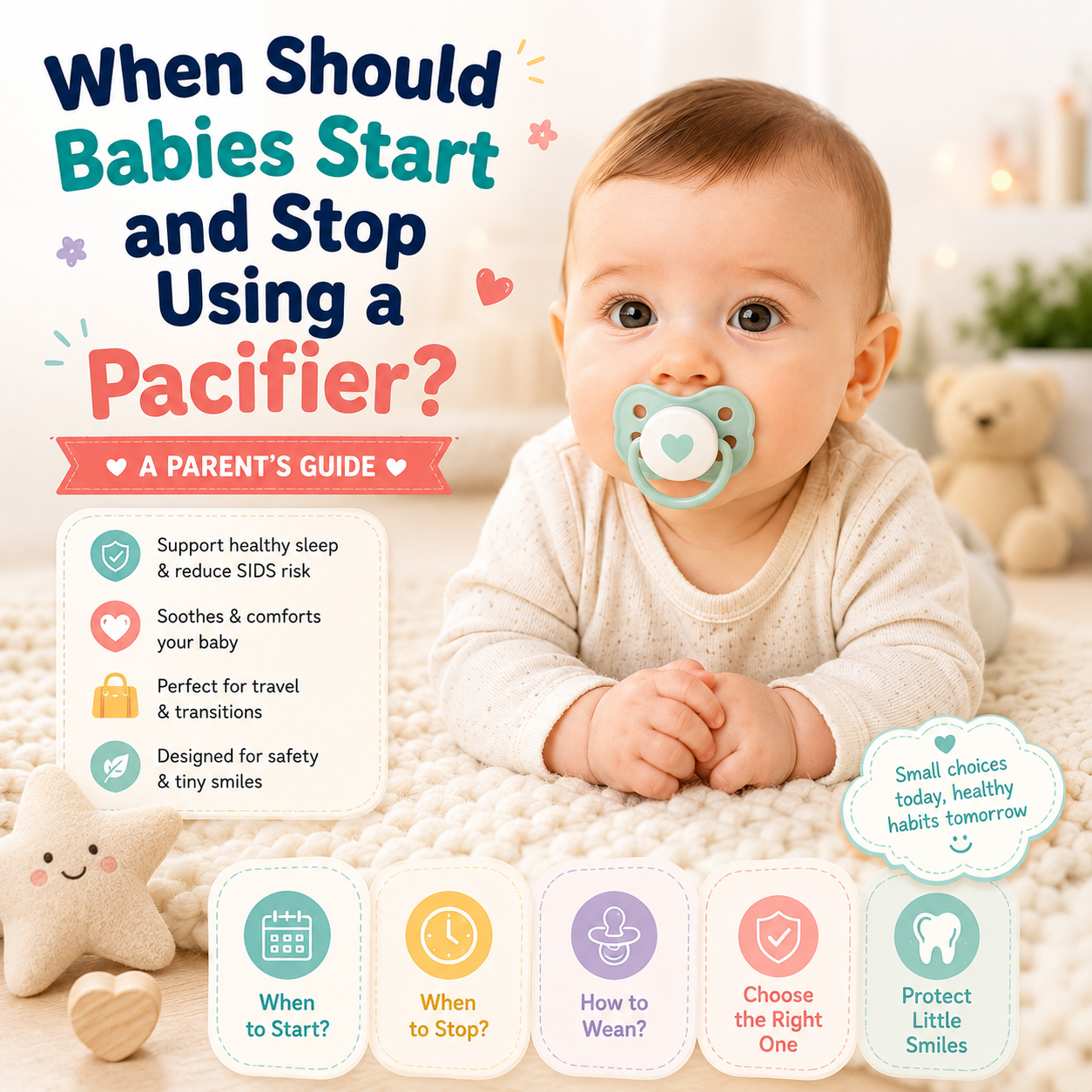
Pacifiers are one of the most debated items in baby care. Some parents swear by them, while others avoid them entirely. The truth is, pacifiers can be a safe and beneficial tool for soothing infants when used correctly — but timing matters.
This guide explains when it is appropriate to introduce a pacifier, how long babies should use one, when to begin weaning, and how to choose the right pacifier for your child’s age and development. Whether you are a new parent in South Africa, India, Southeast Asia, or the Middle East, the guidance here applies universally.
What Is a Pacifier and How Does It Work?
A pacifier is a nipple-shaped device made from silicone, rubber, or latex that babies suck on for comfort. The sucking reflex is one of the strongest instincts in newborns and is present even when a baby is not hungry. Pacifiers satisfy this need for non-nutritive sucking, which has a calming effect on the nervous system.
There are two primary types:
- Standard pacifiers — round nipple shape, widely available
- Orthodontic pacifiers — flattened nipple shape designed to minimise pressure on developing teeth and jaw
When Should You Introduce a Pacifier?
The recommended time to introduce a pacifier depends on whether you are breastfeeding.
For breastfeeding mothers
Most paediatric and lactation experts recommend waiting until breastfeeding is well-established before introducing a pacifier. This typically means waiting until your baby is 3–4 weeks old. Introducing a pacifier too early can cause nipple confusion, where the baby struggles to latch correctly on the breast, and may reduce feeding frequency enough to affect your milk supply.
Signs that breastfeeding is well-established:
- Baby is latching well and feeding efficiently at every session
- Milk supply feels consistent and responsive
- Baby is gaining weight at the expected rate
- Feeding sessions are settled and not distressing
For formula-fed babies
If you are bottle-feeding with formula, a pacifier can be introduced from birth or within the first few days, as there is no breastfeeding routine to protect. However, do not use a pacifier as a substitute for feeding. Always ensure your baby’s hunger cues are addressed first.
Benefits of Pacifier Use in Infants
When used appropriately, pacifiers offer several well-documented benefits:
- Reduced risk of Sudden Infant Death Syndrome (SIDS) — major health organisations including the American Academy of Pediatrics (AAP) recommend pacifier use at sleep time during the first year of life as a protective measure
- Soothing during medical procedures such as vaccinations and blood draws
- Calming during travel and transitions — particularly useful for families in busy urban environments across Asia and Africa
- Satisfying the non-nutritive sucking reflex without overfeeding
- Easier settling at naps and bedtime
Potential Risks of Pacifier Use
Pacifier use is not without its considerations. Parents should be aware of the following:
- Nipple confusion in early breastfeeding if introduced before 3–4 weeks
- Dental misalignment if pacifier use continues beyond 2–3 years, particularly with non-orthodontic designs
- Increased risk of ear infections (otitis media) with prolonged use beyond 12 months
- Dependency — some toddlers become strongly attached and find weaning difficult
- Hygiene concerns if the pacifier is not cleaned and replaced regularly
When Should You Stop Using a Pacifier?
This is where many parents struggle. There is no single universal answer, but the following age-based guidance reflects current paediatric recommendations.
By 6–12 months
Begin limiting pacifier use to sleep times only. At this stage, your baby is becoming more interactive, vocal, and aware of their surroundings. Constant daytime pacifier use can interfere with babbling and early language development, which requires unrestricted mouth movement.
By 12–18 months
Many paediatric dentists recommend starting the weaning process by 12 months. At this age, children are developing their first teeth and jaw structure. Prolonged pacifier use can begin to affect bite alignment, particularly the front teeth.
By 2–3 years at the latest
Most experts agree that pacifier use should stop entirely by age 2–3. Beyond this point, the risk of dental problems increases significantly, and the habit becomes harder to break with every passing month.
How to Wean Your Baby Off a Pacifier
Weaning from a pacifier requires patience and consistency. Abrupt removal can cause distress, particularly in children who have used one from early infancy. The following strategies work well:
- Gradual reduction — limit use to sleep times first, then to bedtime only, then phase out completely over several weeks
- Distraction and substitution — introduce a comfort toy, blanket, or soothing routine to replace the pacifier at bedtime
- Positive reinforcement — celebrate and acknowledge your child’s progress without pressure
- The cold-turkey approach — for children over 2 who understand simple reasoning, some families find removing it entirely with an honest explanation works effectively
- The ‘snip’ method — trimming the tip of the nipple gradually makes sucking less satisfying and often leads to natural self-weaning
How to Choose the Right Pacifier
Selecting the right pacifier for your baby’s age and development reduces the risk of dental and oral health issues.
Age-based sizing
- Size 1 (0–6 months) — small nipple and shield, suitable for newborns
- Size 2 (6–18 months) — medium nipple, designed for growing babies
- Size 3 (18 months+) — larger shape for toddlers
Material considerations
- Silicone nipples — durable, easy to clean, odourless, and hypoallergenic — the preferred choice for most parents
- Latex nipples — softer and more flexible but less durable and may cause allergies in some babies
- Always choose BPA-free, food-grade certified pacifiers
Royal Baby Products manufactures BPA-free pacifiers in orthodontic and standard designs, available in multiple sizes, and distributed to markets including South Africa, India, Thailand, and the Middle East.
Pacifier Hygiene — Keeping It Safe
- Sterilise before first use and after any time the pacifier falls on the floor
- Replace pacifiers every 4–6 weeks or at any sign of discolouration, stickiness, or material breakdown
- Never clean a pacifier by sucking on it yourself — this transfers adult oral bacteria to the baby
- Never coat a pacifier in honey, sugar, or juice to encourage acceptance
Conclusion
Used within the right time window and with proper hygiene, pacifiers are a safe and effective tool for soothing infants. The key is intentional use — introducing at the right time, limiting use as the baby grows, and beginning the weaning process before dental or behavioural dependency becomes entrenched.
Royal Baby Products provides a full range of orthodontic and standard pacifiers designed to international safety standards, suitable for babies from birth through the toddler stage. Our products are trusted by parents and distributors across South Africa, India, Southeast Asia, and the Middle East.
Frequently Asked Questions
Q: Can I give my newborn a pacifier immediately after birth?
A: If you are breastfeeding, wait until 3–4 weeks when breastfeeding is established. For formula-fed babies, pacifiers can be introduced from birth.
Q: Does pacifier use affect speech development?
A: Only if used excessively during waking hours. Limiting pacifier use to sleep times after 6 months minimises any impact on early language development.
Q: What age do most children naturally stop using a pacifier?
A: Many children self-wean between 2–4 years. However, relying on natural self-weaning risks dental problems if the habit extends past age 3.
Q: Is it safe to use a pacifier while baby sleeps?
A: Yes. Pacifier use during sleep is associated with a reduced risk of SIDS in the first year of life, as recommended by the AAP.
Q: How do I find the right pacifier size for my baby?
A: Royal Baby Products pacifiers are available in age-appropriate sizes. Check the packaging for the recommended age range and replace as your baby grows.
Leave a Reply