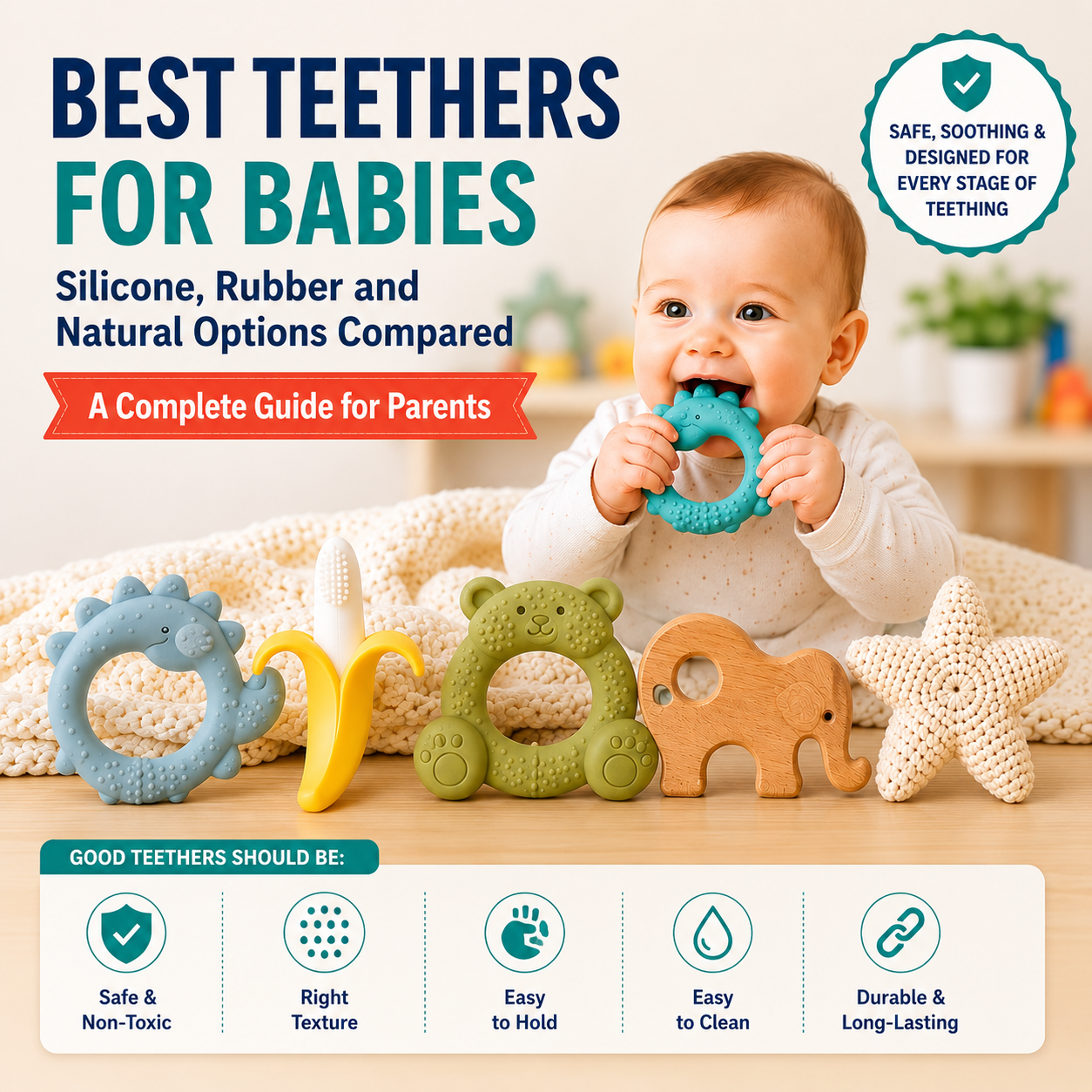
Teething is one of the most challenging phases of a baby’s early development. It typically begins around 4–7 months of age and can continue until the age of 3 as the full set of primary teeth comes through. During this time, gum discomfort and irritability are common, and parents across South Africa, India, Southeast Asia, and the Middle East are often looking for the most effective and safest way to provide relief.
A good teether does more than just give babies something to chew on. It stimulates the gums, supports early oral muscle development, and can significantly reduce teething distress. This guide compares the three most popular types of baby teethers — silicone, rubber, and natural materials — to help you make an informed choice.
Understanding Teething — What Is Actually Happening?
As a baby’s teeth begin pushing through the gum line, the pressure causes localised inflammation and soreness. Babies respond to this by gnawing and chewing on anything within reach, which provides counter-pressure that relieves discomfort.
Common teething signs include:
- Excessive drooling — often the earliest sign
- Irritability, fussiness, or difficulty settling
- Chewing on fingers, toys, or feeding bottles
- Swollen or red gum patches
- Mild disruption to feeding and sleeping routines
While a slight increase in temperature is common, high fever is not a teething symptom and should always be assessed by a healthcare professional.
What Makes a Good Baby Teether?
Before exploring specific materials, it helps to understand what parents should look for in any teething toy:
- Safe materials — free from BPA, phthalates, PVC, lead, and toxic dyes
- Appropriate texture — firm enough to provide counter-pressure but not hard enough to damage emerging teeth
- Correct size and shape — large enough that it cannot be swallowed, with handles or grip areas for small hands
- Easy to clean and sterilise
- Durable — resistant to cracking, peeling, or breaking apart under bite pressure
Silicone Teethers — The Most Popular Choice
Silicone is currently the most widely used material for baby teethers globally, and for good reason.
Why parents choose silicone teethers
- Food-grade silicone is completely non-toxic, odourless, and tasteless
- Highly resistant to bacteria — non-porous surface does not absorb germs or odours
- Flexible yet firm, providing effective gum relief without damaging teeth
- Withstands high-temperature sterilisation methods including boiling and steam
- Durable and long-lasting — does not degrade with repeated use or sterilisation
- Available in a wide range of shapes, colours, and textures
Things to consider
- Not all silicone teethers are food-grade — always check certifications
- Avoid teethers with liquid or gel filling inside silicone (often marketed as ‘cooling’ teethers) — these can leak or harbour bacteria if punctured
- Some cheaper silicone products may contain fillers; buy from trusted, certified manufacturers
Silicone teethers are particularly well-suited to hot and humid climates such as Thailand, Malaysia, and coastal South Africa, where hygiene maintenance is a priority due to faster bacterial growth in warm conditions.
Rubber Teethers — A Trusted Classic
Natural rubber teethers have been used for generations and remain a popular option, particularly among parents seeking non-synthetic materials.
Why parents choose rubber teethers
- Natural rubber is soft and pliable — closely mimics the feel of the breast or bottle nipple
- Provides excellent counter-pressure to sore gums
- Biodegradable and more environmentally sustainable than synthetic materials
- Naturally derived from rubber trees, making it a preferred option for eco-conscious families
Things to consider
- Natural rubber can cause allergic reactions in babies with latex sensitivity
- Rubber degrades faster than silicone, particularly under high-heat sterilisation — inspect regularly for cracking or stickiness
- Rubber teethers must not be dishwasher cleaned as heat exposure accelerates degradation
- In hot climates, rubber teethers should be stored in cool, dry conditions to prolong their lifespan
Natural Teethers — Wood, Organic Cotton and More
Natural teethers encompass a range of materials including untreated wood, organic cotton, and plant-based composites. These options appeal strongly to parents across markets like India and Southeast Asia, where there is cultural familiarity with natural materials in childcare.
Wooden teethers
- Should be made from food-grade, untreated hardwood (maple, beech, or birch are common choices)
- Firm surface provides strong counter-pressure for babies with multiple teeth coming through simultaneously
- Free from synthetic chemicals when uncoated
- Must be kept dry after use — wood absorbs water and can develop mould if not dried thoroughly
- Not suitable for high-heat sterilisation — clean with a damp cloth and mild soap only
Organic cotton teethers
- Soft fabric texture soothes sensitive gums in the earliest stages of teething
- Machine washable and easy to maintain
- Best suited to early teething (4–6 months) when teeth have not yet emerged
- Less effective for later-stage teething when firmer counter-pressure is needed
- Check that no dyes or synthetic coatings have been applied to the fabric
Side-by-Side Comparison: Silicone vs Rubber vs Natural
Safety: Silicone — food-grade, chemical-free | Rubber — natural but latex allergy risk | Natural — safe if untreated
Texture: Silicone — firm and flexible | Rubber — soft and pliable | Natural — varies by material
Durability: Silicone — very high | Rubber — moderate | Natural — depends on material
Sterilisation: Silicone — boiling, steam, UV | Rubber — wipe clean only | Natural — wipe clean only
Eco-friendliness: Silicone — not biodegradable | Rubber — biodegradable | Natural — most sustainable
Best age: Silicone — all stages | Rubber — early to mid teething | Natural — early teething stage
Hot climate suitability: Silicone — excellent | Rubber — good with care | Natural — moderate
Teether Safety — What to Avoid
Despite the wide availability of teething products, not all options are safe. Parents should actively avoid:
- Teething gels containing benzocaine or lidocaine — these can cause rare but serious side effects in infants and are not recommended by most paediatric bodies
- Amber teething necklaces — pose a choking and strangulation risk and have no scientifically proven benefit
- Teethers with small detachable parts — any component that can break off poses a choking hazard
- Liquid-filled teethers — the filling can leak and harbour bacteria if the outer layer is punctured
- Products without safety certifications — always look for CE, FDA, or equivalent certification
How to Clean and Care for Teethers
- Silicone teethers — boil for 3–5 minutes or use a steam steriliser; rinse well and air dry
- Rubber teethers — wipe with a damp cloth and mild soap; allow to dry fully before use
- Wooden teethers — wipe clean immediately after use; never soak in water
- Cotton teethers — machine wash on a gentle cycle and air dry
- Replace any teether that shows signs of cracking, peeling, discolouration, or material breakdown
Recommended Teethers by Age
- 4–6 months — soft silicone or organic cotton teethers as first teeth begin emerging
- 6–9 months — firmer silicone or rubber teethers with textured surfaces and easy grip handles
- 9–12 months — multi-surface silicone teethers targeting back gum areas as molars begin
- 12 months and beyond — transition to textured chew toys or teething rings as all primary teeth emerge
Conclusion
Choosing the right teether comes down to your baby’s age, your priorities around materials, and the practicalities of your environment. Silicone offers the most versatility and hygiene benefits, making it the go-to choice for most families globally. Rubber provides a natural, soft option for early teething with proper care. Natural teethers offer sustainability but require more maintenance.
Royal Baby Products manufactures food-grade silicone teethers and pacifiers certified to international safety standards. Our products are designed to meet the needs of parents across South Africa, India, Southeast Asia, and the Middle East — wherever you are raising your baby, we are committed to helping you do it safely.
Frequently Asked Questions
Q: At what age should I introduce a teether?
A: Teethers can be introduced from around 3–4 months, before any teeth emerge, to help soothe the early gum sensitivity that precedes teething.
Q: Are silicone teethers safe for newborns?
A: Silicone teethers sized appropriately for newborns (with no small parts) are safe from birth. Always check that the product is food-grade and certified.
Q: How often should I replace a teether?
A: Inspect teethers at every use. Replace immediately if you notice any cracks, stickiness, discolouration, or weakening of the material.
Q: Can I freeze a teether for extra relief?
A: A chilled teether (refrigerated, not frozen) can provide additional relief. Avoid freezing as it can make the teether too hard and damage emerging teeth.
Q: What is the safest teether material for a baby with sensitive skin?
A: Food-grade silicone is generally the safest option as it is hypoallergenic, non-porous, and free from latex, BPA, and other potential irritants.
Leave a Reply